
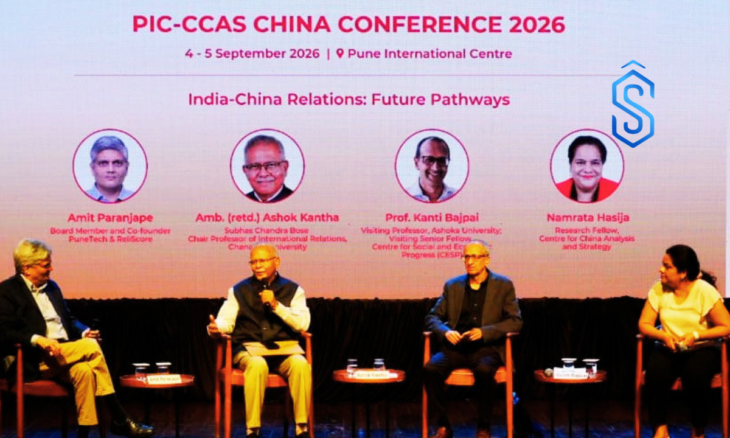
Pune: The PIC-CCAS China Conference 2026 in Pune brought together strategic experts, defence specialists and industry leaders to examine the People’s Liberation Army’s (PLA) military capabilities, India’s deterrence options, India-China business relations and opportunities for strengthening domestic manufacturing and supply chains.
The discussions at the PIC-CCAS China Conference 2026 covered China’s military effectiveness despite recent senior-level purges, India’s preparedness for emerging forms of warfare, the need for greater military integration, electric-vehicle (EV) supply chains, China’s manufacturing scale and the opportunities arising from the global “China+1” strategy.
PLA’s military effectiveness remains intact despite purges: Experts
The military effectiveness of the People’s Liberation Army (PLA) has not diminished despite recent purges of senior commanders, strategic experts said during a panel discussion titled “Is All Well with the PLA?” on the second day of the PIC-CCAS China Conference 2026 in Pune.
The session was chaired by Nitin Gokhale, Founder, StratNews Global, and featured Brig. (Retd.) Anshuman Narang, Founder, Atmanirbhar Soch; Rear Admiral (Retd.) Monty Khanna, Adjunct Honorary Fellow, National Maritime Foundation; and Suyash Desai, Non-Resident Fellow, Foreign Policy Research Institute.
Desai said the PLA’s functional efficiency remained intact despite the purges. He identified two broad approaches to deterrence—deterrence by denial and deterrence by punishment—and noted that the military and economic balance between India and China had changed significantly since the 1980s.
According to Desai, this shift has implications for India’s position along the Line of Actual Control (LAC) and limits the scope for deterrence by punishment. China’s move towards greater military integration through its theatre command structure was another important development, he added.
The PIC-CCAS China Conference 2026 discussion also examined China’s approach to dealing with India and the implications for India’s defence preparedness.
Brig. Narang highlighted what he described as China’s “nibbling tactics” against India and argued that Beijing seeks to achieve its objectives without entering into a full-scale conflict.
He stressed the need for India to develop capabilities to strike deep inside China as a counter to potential Chinese aggression. Drawing lessons from the Ukraine war, he said the emergence of drone warfare should not have come as a surprise and underlined the importance of visualising future conflict scenarios and preparing for them in advance.
Providing a maritime perspective, Rear Admiral Khanna said India needed to focus more sharply on the “Indo” in the Indo-Pacific and build capabilities that serve India’s own strategic interests.
Khanna also pointed to the high cost of defence equipment production in India and linked it to broader purchasing-power and currency considerations.
At the PIC-CCAS China Conference 2026, Khanna called for a much faster pace of change within India’s armed forces and said military integration should have begun much earlier.
Against China, he argued, India needs to create asymmetry through both land and naval deterrence, including capabilities that can impose sustained costs on an adversary’s military.
The panel also discussed asymmetric warfare and lessons from the Ukraine conflict. The question-and-answer session focused on how India could anticipate and respond to emerging forms of warfare.
The discussion further highlighted the potential role of the Pune International Centre (PIC) in facilitating greater interaction among industry, academia and the defence services to strengthen India’s preparedness and strategic capabilities.
India must build EV supply chains at scale to reduce dependence on China: Arvind Goel
The PIC-CCAS China Conference 2026 also turned to India’s manufacturing capabilities and dependence on China, with Arvind Goel of Tata AutoComp Systems Ltd calling for greater domestic capacity in critical electric-vehicle (EV) components and strategic technologies.
India must urgently build domestic capabilities in critical EV components and other strategic technologies, while producing at scale, to reduce its dependence on China, Goel said during a fireside chat at the PIC-CCAS China Conference 2026 in Pune.
Goel, in conversation with Jitendra Divgi, MD, Divgi TorqTransfer Systems Ltd, drew on his experience of operating in China to provide an industry perspective on the country’s manufacturing ecosystem.
He noted that Chinese companies actively employ highly qualified talent, including PhDs, and have developed the ability to manufacture on a very large scale, particularly in the automotive sector.
Responding to Divgi’s question on how India could become more atmanirbhar while addressing its dependence on China, Goel pointed to India’s heavy reliance on China for critical EV components, including batteries.
He stressed that the government must support domestic mining, EV battery manufacturing and semiconductor/chip capabilities, with a strong emphasis on achieving production volumes that can make Indian manufacturing globally competitive.
India has a large pool of engineers whose capabilities need to be harnessed to build these industries, he said.
The PIC-CCAS China Conference 2026 discussion also examined the possibility of India benefiting from the global “China+1” strategy.
Goel noted that countries across the world continue to depend heavily on China for a wide range of products. At the same time, he and Divgi underlined the significant opportunity for India as global companies seek to diversify their supply chains and reduce excessive dependence on China.
They pointed to the expansion of manufacturing operations by global companies such as Tesla and Apple in India as examples of the opportunities emerging from this shift.
India-China business ties: India must localise, diversify and learn from China’s scale
The PIC-CCAS China Conference 2026 also examined India-China economic and business relations, with experts calling for stronger localisation, supply-chain diversification and greater learning from China’s manufacturing and innovation ecosystem.
The views were shared during a panel discussion titled “India-China Business Relations: Opportunities and Challenges” at the PIC-CCAS China Conference 2026 in Pune.
The session was chaired by Dr Ajit Ranade, Senior Fellow, Pune International Centre, and featured Dr Rakesh Mohan, President Emeritus and Distinguished Fellow, Centre for Social and Economic Progress and former Deputy Governor, RBI; Dr Ishita Ghosh, Associate Professor, Symbiosis School of Economics; Dr Sudhir Mehta, Founder and Chairman, Eka Mobility; and Santosh Pai, Partner, Dentons Link Legal.
Pai said that with the WTO system under strain, the global economy was increasingly being organised around major regional trade agreements.
India, he noted, is outside the major trade agreements that are increasingly shaping the global trading system. For Indian industry, the key challenges were localisation and diversification.
At the PIC-CCAS China Conference 2026, Mehta said India should, like China, follow areas where the economic benefits are greatest and avoid excessive short-term thinking.
Industry needs time to develop, he said, while expressing confidence that India’s EV industry could become the world’s largest outside China within two years.
Mehta also urged India to adopt efficient Chinese industrial practices and make greater use of its abundant solar potential, including for electric mobility, which could substantially reduce transportation costs.
Dr Mohan stressed the importance of supporting engineering, R&D and access to land.
Except in sensitive sectors, he said, India should consider allowing Chinese investment in labour-intensive industries.
Dr Ghosh raised the issue of currency competitiveness, with Dr Mohan observing that the currency becomes a major constraint particularly when a country has weak exports.
The panel at the PIC-CCAS China Conference 2026 underlined the need for a pragmatic India-China economic engagement that combines domestic capability-building with global supply-chain opportunities.